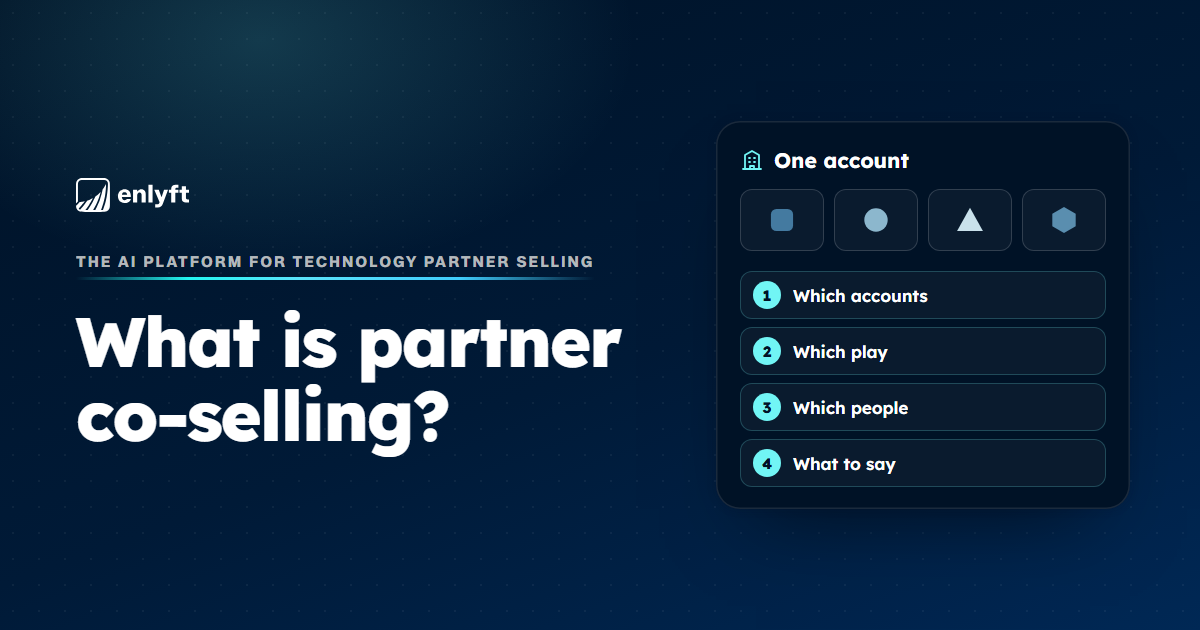
Partner co-selling is a technology vendor and its partner working the same customer account together to win the sale. The partner is a technology provider such as an MSP, VAR, systems integrator or distributor. The vendor makes the software, cloud or hardware the partner sells. AWS and Microsoft use “co-sell” as the name of their own programs, where a partner registers a deal through AWS ACE or Microsoft Partner Center and works it with the vendor’s sellers. That registration is the visible part. Most of the work happens earlier, before there is a deal to register: finding which accounts are ready to buy, and which vendor’s product to lead with.
What does it look like on one account?
An example. The company is made up.
A manufacturer with 400 employees runs Microsoft 365. Most of its laptops are still on Windows 10. Its ordering system runs on AWS. Nobody at your firm has ever called it. It bought its Microsoft licences years ago from another provider and has been quiet since.
What each vendor sees. AWS sees one workload that runs fine and hasn’t grown in a year. Microsoft sees a licence count. Each one looks only at its own product and asks whether this company needs more of it. The answer is usually “not this quarter”, and the account drops down the list.
What a partner seller sees. You sell three vendors’ products into companies like this one: Microsoft 365 and Windows devices, AWS, and a backup and security vendor. So you ask which of the three this account is ready for now.
Vendor you sell
What the account runs
Signal
Ready now?
Microsoft: Windows devices
Laptops still on Windows 10
Windows 10 reached end of support on October 14, 2025 (Microsoft). The company posted a job for an IT manager to lead a PC refresh.
Yes. Start here.
Backup and security
Nothing beyond the Microsoft 365 defaults
No signal of its own yet
Next. It comes up during the refresh.
AWS
One ordering workload
No change in 12 months
Not now
You open on the laptops. The reason to call is specific: their devices are past end of support, and they are hiring someone to replace them. Security follows from the same project. AWS waits until something changes.
None of this is a co-sell deal yet. There is nothing to register until you have a conversation and a project. If the project grows into one the vendor’s team can help with, that is when registration comes in. Everything before it was yours to work out.
Knowing which of your accounts is ready to buy which vendor’s product, and why now, is the hard part. Here it took three facts about one company. You have hundreds of companies, and those facts change every month.
Why does it matter?
Most business technology still reaches customers through partners. According to Omdia (2026), partners will deliver 66.7% of the worldwide addressable IT market in 2026, a market Omdia sizes at $6.07 trillion (Omdia).
Partners in the AWS and Microsoft programs use “co-sell” because the programs do. Many MSPs don’t use the word at all. They talk about finding the customer. The CEO of an AWS services partner put it plainly: “the most difficult part is to find the customer.”
What has to happen before there is a deal?
Four things, in order, each built on the one before. Here they are on the example account.
Which accounts are ready to buy, and why now. This comes from known buying signals and fit, not a static list. The manufacturer qualifies because its laptops are past end of support and it’s hiring to replace them.
Which play to run there. Which vendor’s product and which use case, based on what the account already runs. Here that’s the device refresh first, with security as the follow-on.
Which people that play calls for. And why each one matters to the deal. For a refresh, that’s whoever runs IT today and whoever approves hardware spend.
What to say to them. A sequence of messages the seller reviews and sends. Here they open on the end-of-support date and the refresh they are already hiring for.
Get one step wrong and the rest fail with it. A strong message to the wrong person goes nowhere. The right person at an account that isn’t ready is a wasted call. Skipping steps is where “spray and pray” comes from: the same email to every account on your list, sent in the hope that a few of them happen to be ready.
The first step is the hard one, and it doesn’t stay done. Companies change what they run and signals come and go, so a list built once goes stale while you are still working it. It is hardest on accounts like the manufacturer, where nobody at your firm or the vendor has an opening and you need a credible reason to reach out.
Illustration: one example account, three vendors, one ready now.
How is co-selling different from direct selling and channel sales?
A direct seller sells one product to the accounts they choose. A partner seller works a customer list where each account already runs several vendors’ products. The question at each account changes from whether the company needs this product to which of the products you sell it is ready for, and why now.
The vendor holds part of that answer. It knows things about its own customers that a partner can’t see from outside, and the partner knows its customers in ways the vendor can’t. Co-selling works best when the account pick uses what both sides know.
Channel sales is the broader model. In B2B technology, it means a vendor selling through partners such as resellers, MSPs, systems integrators and distributors, instead of or alongside its own sales team. A lot of channel sales happens without the vendor in the conversation, such as a partner renewing licences for a customer it already manages. Co-selling is the joint, account-level part of channel sales: partner and vendor working one specific customer together.
The AWS and Microsoft programs formalise that joint part. Partner and vendor register a deal and work it together through AWS ACE or Microsoft Partner Center. Co-selling is bigger than the registration. A partner works out which accounts are ready, and which vendor’s product to lead with, for every vendor it sells, with or without a program behind it. In the example, nothing was registered when the partner found the device refresh. Any co-sell registration with Microsoft would come after.
What software supports co-selling?
Several categories, each built for a different job.
Category
Built for
Partner relationship management (PRM)
Running a vendor’s partner program: onboarding, deal registration, MDF, enablement.
Account mapping and second-party data sharing
Showing which accounts overlap between partner and vendor CRMs.
Co-sell and marketplace workflow
Registering and sharing joint deals in AWS and Microsoft partner programs, and handling marketplace transactions.
Contact data and sales engagement
Finding contacts, enriching records and running outreach sequences, for any sales team.
Propensity and account intelligence
Showing which accounts are ready to buy, the play, the contacts and a drafted sequence for the seller to review. Enlyft sits here.
A team can run several of these side by side. Account mapping only covers the accounts you and the vendor already share, so the manufacturer in the example wouldn’t appear in it. Co-sell workflow starts once there is a deal to register. Propensity covers every company you could sell to, including the ones nobody is working yet, so it finds the accounts worth registering in the first place.
Where does Enlyft fit?
Enlyft is the AI platform for technology partner selling. It finds the accounts ready to buy, picks the plays for each account from what it already runs and the signals it shows, identifies the contacts each play calls for and why each matters, and drafts the outreach sequence for the seller to review and send.
Most of the value sits in accounts like the manufacturer: the whitespace nobody at your firm is working yet. On accounts the vendor already manages, the vendor’s own data covers much of the same ground. Enlyft’s known buying signals run on install-base data covering 45M+ companies and 24,000+ technologies. It works across every vendor you sell, and with the stack your team already runs.
Enlyft is the intelligence engine behind Microsoft CloudAscent. The Microsoft case study reports 3x higher conversion on “Act Now” recommendations for accounts prioritized with CloudAscent data. Microsoft’s Tech Community explains what CloudAscent is and how eligible partners download their customer propensity data from Partner Center.
For software vendors, Deck Commerce reported a 47% lift in closed-won bookings from a program that used Enlyft for its ICP, demand generation and partner selling.
When the account work is already done, or there is none to do.
A vendor that sells one product through its own direct team isn’t co-selling with anyone, so a platform built for partners has nothing to add. A partner that fulfils orders its vendor or the customer brings in doesn’t need to find accounts. A customer list small enough that you already know which accounts are ready can be worked from memory and a spreadsheet.
The software earns its place when you have too many accounts to know by heart and too many vendors to track by hand.
Related questions
Is co-selling the same as channel sales?
No. Channel sales is the wider model: a technology vendor selling through partners such as resellers, MSPs, systems integrators and distributors. Much of it happens without the vendor involved, such as a partner renewing licences for its own customer. Co-selling is the part of channel sales where partner and vendor work a specific account together.
Do you need a formal co-sell program to co-sell?
No. A partner works out which accounts are ready, the play, the contacts and the outreach for every vendor it sells, whether or not that vendor runs a program. A formal program, such as AWS ACE or Microsoft Partner Center, adds deal registration and joint work with the vendor’s own sellers once the partner has found the deal.
Is this for technology vendors or for partners?
Both, in different ways. For a partner, co-selling brings the vendor’s help onto accounts the partner has found, and its sellers still decide which customers to call, for which vendor, and when. The channel partners page covers that side. For a technology vendor, co-selling is how its alliance and channel teams help each partner find the accounts ready for the vendor’s products, across the whole partner base at once. The software vendors page covers that side.
Does this apply to MSPs?
Yes, though few MSPs call it co-selling. For an MSP the work is knowing which customers, existing or new, are ready for which vendor’s product. When a deal needs the vendor’s help, or the vendor runs a program the MSP belongs to, that work becomes co-selling.
Does co-selling only happen with AWS and Microsoft?
No. AWS and Microsoft both call their partner programs co-sell, so the term is common among their partners. Any vendor that sells through partners can work accounts jointly with them, with or without a formal program. A partner selling a smaller vendor’s software faces the same question at each account as a partner selling a hyperscaler’s cloud.
Is a technology partner the same as a sales partner?
Not always. In many vendor programs, a technology partner is a company that builds on the vendor’s product. ZINFI describes a technology partner as an organization that “builds a technical integration, complementary application, or jointly developed solution with a vendor’s platform” (ZINFI). That is a build relationship. A co-selling partner has a sales relationship: it resells, delivers or manages a vendor’s technology for its customers and works accounts with the vendor. The same company can be both, building an integration with one vendor while it resells another vendor’s products.